Event Lifecycle
This document describes the complete lifecycle of a security event from creation through deletion, including state transitions, data transformations, and retention policies.
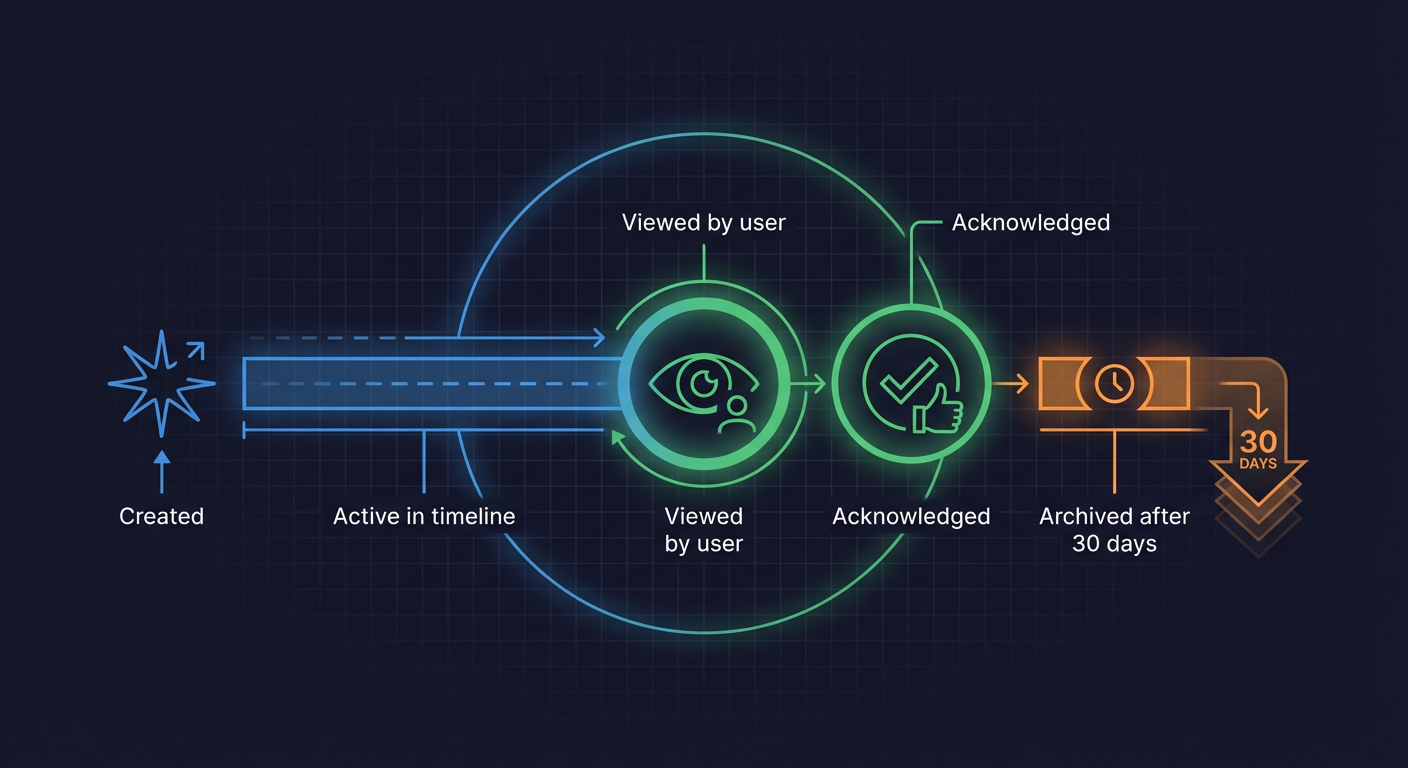
Event State Machine
Events carry no status column. Their lifecycle is driven by boolean/timestamp fields on backend/models/event.py (reviewed, flagged, snooze_until, deleted_at) plus the retention cleanup job.
stateDiagram-v2
    [*] --> Created: LLM analysis complete
    Created --> Broadcasted: WebSocket notification sent
    Broadcasted --> Reviewed: PATCH /api/events/{id} sets reviewed=true
    Broadcasted --> SoftDeleted: DELETE sets deleted_at
    SoftDeleted --> Broadcasted: POST /api/events/{id}/restore
    Reviewed --> SoftDeleted: DELETE sets deleted_at
    Broadcasted --> Purged: retention_days (default 30) elapsed
    Reviewed --> Purged: retention_days (default 30) elapsed
    SoftDeleted --> Purged: cleanup DELETE
    Purged --> [*]
There is no resolve step: alert instances are acknowledged or dismissed via POST /api/alerts/{alert_id}/acknowledge and POST /api/alerts/{alert_id}/dismiss (backend/api/routes/alerts.py:566, 657); events themselves are reviewed or snoozed.
Event Creation
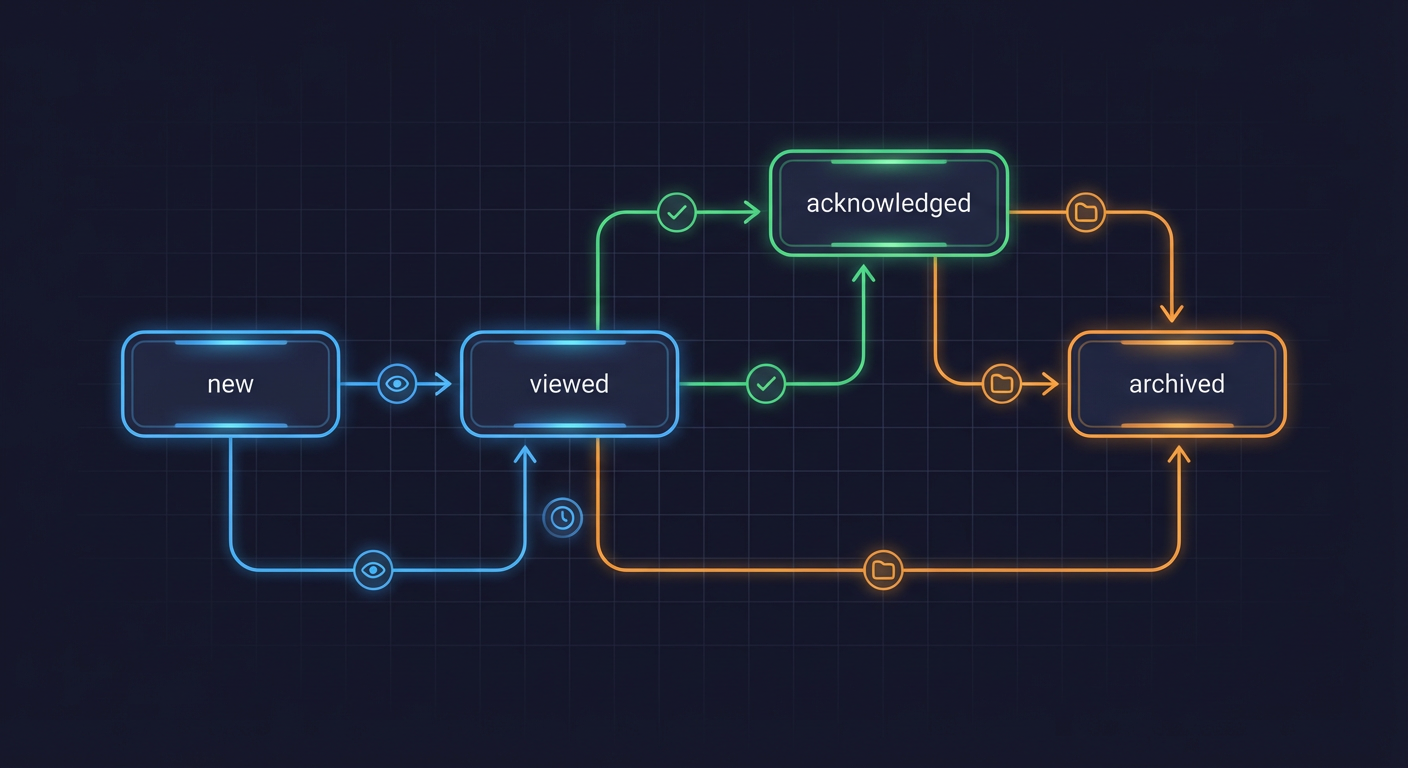
Source: backend/services/nemotron_analyzer.py:6-17
Creation Trigger
Events are created after successful LLM analysis of a detection batch:
# backend/services/nemotron_analyzer.py:6-17
# Analysis Flow:
#     1. Fetch batch detections from Redis/database
#     2. Enrich context with zones, baselines, and cross-camera activity
#     3. Run enrichment pipeline for license plates, faces, OCR (optional)
#     4. Format prompt with enriched detection details
#     5. Acquire shared AI inference semaphore (NEM-1463)
#     6. POST to llama.cpp completion endpoint (with retry on transient failures)
#     7. Release semaphore
#     8. Parse JSON response
#     9. Create Event with risk assessment    <-- Event Created
#     10. Store Event in database
#     11. Broadcast via WebSocket (if available)
Event Data Model
# Core event fields
Event:
    id: int                    # Primary key, auto-increment
    batch_id: str              # Links to detection batch (e.g., "batch-a1b2c3d4")
    camera_id: str             # Normalized camera ID (e.g., "front_door")
    risk_score: int            # 0-100, from LLM analysis
    risk_level: str            # Derived: "low", "medium", "high", "critical"
    summary: str               # Human-readable description
    reasoning: str             # LLM reasoning for assessment
    started_at: datetime       # First detection in batch
    ended_at: datetime | None  # Last detection in batch (optional)
    reviewed: bool             # Marked reviewed by a user (also drives hsi_events_reviewed_total)
    snooze_until: datetime     # NEM-2359 — suppress until this time
    deleted_at: datetime       # Soft delete (restorable until cleanup purges it)
    version: int               # Optimistic-locking counter (NEM-3625)
    # Event has no created_at column — started_at is the event's time reference.
Risk Level Derivation
The Nemotron response supplies risk_score/risk_level; Event.computed_risk_level (backend/models/event.py:367-399) re-derives the level from configurable thresholds (severity_low_max/severity_medium_max/severity_high_max, backend/core/config.py:2288-2303):
| Score Range | Risk Level |
|---|---|
| 0-29 | low |
| 30-59 | medium |
| 60-84 | high |
| 85-100 | critical |
Safety override (NEM-5566): a fire detection forces risk_score = 100 and risk_level = "critical" regardless of LLM output (backend/services/nemotron_analyzer.py:2845-2860).
Event Broadcasting
Source: backend/services/event_broadcaster.py:335-400
Broadcast Sequence
sequenceDiagram
    participant NA as NemotronAnalyzer
    participant EB as EventBroadcaster
    participant Redis as Redis Pub/Sub
    participant WS1 as WebSocket Client 1
    participant WS2 as WebSocket Client 2

    NA->>EB: broadcast_event(event_data)
    EB->>EB: Add sequence number
    EB->>EB: Check requires_ack
    EB->>EB: Buffer message
    EB->>Redis: PUBLISH to channel
    Redis-->>WS1: Message
    Redis-->>WS2: Message

    alt High-priority (risk_score >= 80)
        WS1-->>EB: ACK
        WS2-->>EB: ACK
        EB->>EB: Track ACKs
    end
Message Format
{
  "type": "event",
  "sequence": 42,
  "requires_ack": true,
  "data": {
    "id": 1,
    "event_id": 1,
    "batch_id": "batch_abc123",
    "camera_id": "front_door",
    "risk_score": 85,
    "risk_level": "critical",
    "summary": "Person detected at front door",
    "reasoning": "Unknown individual approaching entrance during nighttime hours",
    "started_at": "2025-12-23T12:00:00Z"
  }
}
Acknowledgment Requirements
Source: backend/services/event_broadcaster.py:296-323
# backend/services/event_broadcaster.py:296-323
def requires_ack(message: dict[str, Any]) -> bool:
    """Determine if a message requires client acknowledgment.

    High-priority messages that require acknowledgment:
    - Events with risk_score >= 80
    - Events with risk_level == 'critical'
    """
    if message.get("type") != "event":
        return False

    data = message.get("data")
    if not data:
        return False

    # Check risk_score >= 80
    risk_score = data.get("risk_score", 0)
    if risk_score >= 80:
        return True

    # Check risk_level == 'critical'
    risk_level = data.get("risk_level", "")
    return bool(risk_level == "critical")
Message Sequencing and Buffering
Source: backend/services/event_broadcaster.py:68-69, 398-401
# backend/services/event_broadcaster.py:68-69
# Buffer size for message replay on reconnection (NEM-1688)
MESSAGE_BUFFER_SIZE = 100

# backend/services/event_broadcaster.py:398-401
# Message sequencing and buffering (NEM-1688)
self._sequence_counter = 0
self._message_buffer: deque[dict[str, Any]] = deque(maxlen=self.MESSAGE_BUFFER_SIZE)
self._client_acks: dict[WebSocket, int] = {}
Features:
- Monotonically increasing sequence numbers
- Last 100 messages buffered for replay
- Per-client ACK tracking for delivery confirmation
Event Review / Acknowledgment
Review Flow
"Viewing" an event has no backend effect; the dashboard marks events reviewed by PATCHing the event itself (backend/api/routes/events.py:1869-2060):
sequenceDiagram
    participant User as Frontend User
    participant FE as Frontend App
    participant API as Backend API
    participant DB as PostgreSQL

    User->>FE: Mark reviewed / add notes / snooze
    FE->>API: PATCH /api/events/{id} {reviewed: true, version: N}
    API->>DB: UPDATE event (audit log + commit)
    DB-->>API: Success (version incremented)
    API-->>FE: 200 OK (updated EventResponse)
API Endpoint
PATCH /api/events/{event_id}

Body (all optional): reviewed, notes, snooze_until, version
  - Include `version` for optimistic locking (NEM-3625): a stale version
    returns 409 with {"detail": {"current_version": N}}.

Response: the full updated Event (risk fields plus reviewed/notes/snooze_until).
Side effects: hsi_events_reviewed_total and hsi_events_acknowledged_total are
recorded when reviewed flips to true (NEM-770 / NEM-3288); cache is invalidated
(NEM-1938). No WebSocket broadcast is sent for the update.
Event Deletion (Soft Delete)
Events are soft-deleted and restorable; there is no "resolved" state.
DELETE /api/events/{event_id}            → sets deleted_at
POST   /api/events/{event_id}/restore    → clears deleted_at (409 if not deleted)
GET    /api/events/deleted               → list soft-deleted events
DELETE /api/events/bulk                  → per-item results (207 Multi-Status)
Rows stay until the cleanup job hard-deletes them once started_at is older than the retention cutoff. Alert-instance workflow (acknowledge/dismiss) is separate: backend/api/routes/alerts.py:566, 657.
Event Archival
Retention Policy
Default retention: 30 days
There is no archive table: old rows are deleted outright by the cleanup service.
Cleanup Process
sequenceDiagram
    participant Scheduler as Cleanup Scheduler
    participant CS as CleanupService
    participant DB as PostgreSQL
    participant RS as Redis (job status)

    Scheduler->>CS: Run cleanup job
    CS->>RS: start_job (cleanup-YYYYMMDD-HHMMSS, data_cleanup)
    CS->>DB: DELETE detections WHERE detected_at < cutoff
    CS->>DB: DELETE events WHERE started_at < cutoff
    CS->>DB: DELETE gpu_stats WHERE recorded_at < cutoff
    CS->>DB: DELETE old logs
    CS->>CS: Delete thumbnail/image files from disk
    CS-->>RS: progress updates, job complete
Cleanup Service
Retention comes from settings, not constants (backend/services/cleanup_service.py:141, 487):
settings.retention_days        # default 30 — events, detections (config.py:927-932)
settings.log_retention_days    # default 7  — logs (config.py:1948-1951)
Cutoff is now(UTC) - timedelta(days=retention_days); events are matched on started_at, detections on detected_at (cleanup_service.py:266-298). A dry run mode (cleanup_service.py:398) reports what would be deleted without deleting it.
Event Data Flow Summary
┌─────────────────────────────────────────────────────────────────────┐
│                         Event Lifecycle                              │
├─────────────────────────────────────────────────────────────────────┤
│                                                                      │
│  Detection Batch     LLM Analysis      Event Creation                │
│  ┌─────────────┐    ┌───────────┐    ┌──────────────┐               │
│  │ detections  │ -> │ Nemotron  │ -> │ PostgreSQL   │               │
│  │ (batch-id)  │    │ (risk)    │    │ INSERT       │               │
│  └─────────────┘    └───────────┘    └──────────────┘               │
│                                             │                        │
│                                             v                        │
│                                      ┌──────────────┐                │
│                                      │ EventBroad-  │                │
│                                      │ caster       │                │
│                                      └──────────────┘                │
│                                             │                        │
│         ┌───────────────────────────────────┼───────────────────┐   │
│         │                                   │                   │   │
│         v                                   v                   v   │
│  ┌──────────────┐                ┌──────────────┐      ┌───────────┐│
│  │ WebSocket    │                │ WebSocket    │      │ WebSocket ││
│  │ Client 1     │                │ Client 2     │      │ Client N  ││
│  └──────────────┘                └──────────────┘      └───────────┘│
│                                                                      │
│  User Interaction                                                    │
│  ┌──────────────┐    ┌──────────────┐    ┌──────────────┐           │
│  │ Review       │ -> │ SoftDelete   │ -> │ Purge        │           │
│  │ (reviewed=1) │    │ (deleted_at) │    │ (30 days)    │           │
│  └──────────────┘    └──────────────┘    └──────────────┘           │
│                                                                      │
└─────────────────────────────────────────────────────────────────────┘
Event Timestamps
| Field | Description | Set When |
|---|---|---|
started_at | First detection in batch | From batch metadata (no created_at column exists on Event) |
ended_at | Last detection in batch | From batch metadata |
snooze_until | Suppressed until | User snoozes the event (NEM-2359) |
deleted_at | Soft-deleted at | DELETE /api/events/{id} |
version | Optimistic-lock counter | Increments on every update (NEM-3625) |
Event Relationships
Event (1) ─────────┬───────── (*) Detection  (many-to-many via event_detections)
                   │
                   ├───────── (1) Camera           (events.camera_id FK)
                   │
                   ├───────── (1) EventAudit       (one quality audit per event)
                   │
                   ├───────── (1) EventFeedback    (one feedback row per event)
                   │
                   └───────── (*) Alert            (alerts triggered by AlertRules)
batch_id is a plain string column linking the event to its upstream detection batch — there is no batches table or FK.
Error Handling
Broadcast Failures
Source: backend/services/event_broadcaster.py:155-254
# backend/services/event_broadcaster.py:155-163 (abridged)
async def broadcast_with_retry[T](
    broadcast_func: Callable[[], Awaitable[T]],
    message_type: str,
    *,
    max_retries: int = DEFAULT_MAX_RETRIES,  # 3
    base_delay: float = DEFAULT_BASE_DELAY,   # 1.0s
    max_delay: float = DEFAULT_MAX_DELAY,     # 30.0s
    metrics: BroadcastRetryMetrics | None = None,
) -> T:
    """Execute a broadcast function with retry logic and exponential backoff."""
Retry Configuration
| Parameter | Value | Source |
|---|---|---|
DEFAULT_MAX_RETRIES | 3 | backend/services/event_broadcaster.py:82 |
DEFAULT_BASE_DELAY | 1.0s | backend/services/event_broadcaster.py:83 |
DEFAULT_MAX_DELAY | 30.0s | backend/services/event_broadcaster.py:84 |
Error Recovery
| Error | Handling | User Impact |
|---|---|---|
| WebSocket closed | Buffer message | Client reconnects, gets buffered messages |
| Redis unavailable | Retry with backoff | Events still created, broadcast delayed |
| Database error | Fail event creation | Detection batch lost |
Metrics and Observability
Event Metrics
hsi_events_created_total- Total events created (backend/core/metrics.py:294)hsi_events_by_risk_level_total- Events by risk level (backend/core/metrics.py:462)hsi_events_by_camera_total- Events by camera (backend/core/metrics.py:652)hsi_events_reviewed_total/hsi_events_acknowledged_total- Review tracking (NEM-770 / NEM-3288,backend/core/metrics.py:659, 667)
Broadcast Metrics
# backend/services/event_broadcaster.py:89-110 (abridged)
@dataclass
class BroadcastRetryMetrics:
    total_attempts: int = 0
    successful_broadcasts: int = 0
    failed_broadcasts: int = 0
    retries_exhausted: int = 0
    retry_counts: dict[int, int] = field(
        default_factory=lambda: {0: 0, 1: 0, 2: 0, 3: 0}
    )  # Count by retry attempts needed
Related Documents
- image-to-event.md - Event creation flow
- websocket-message-flow.md - Broadcast details
- api-request-flow.md - API interaction