Testing Guide
This project follows a strict Test-Driven Development (TDD) approach. All features must have tests written at the time of development.
Test Philosophy
ABSOLUTE RULE: Unit and integration tests must NEVER be disabled, removed, or bypassed.
This rule is non-negotiable. If tests are failing:
- FIX THE CODE - If the implementation is wrong
- FIX THE TESTS - If the tests are incorrect
- NEVER disable, skip, or lower coverage thresholds
See AGENTS.md for the complete policy on testing requirements.
Test Architecture
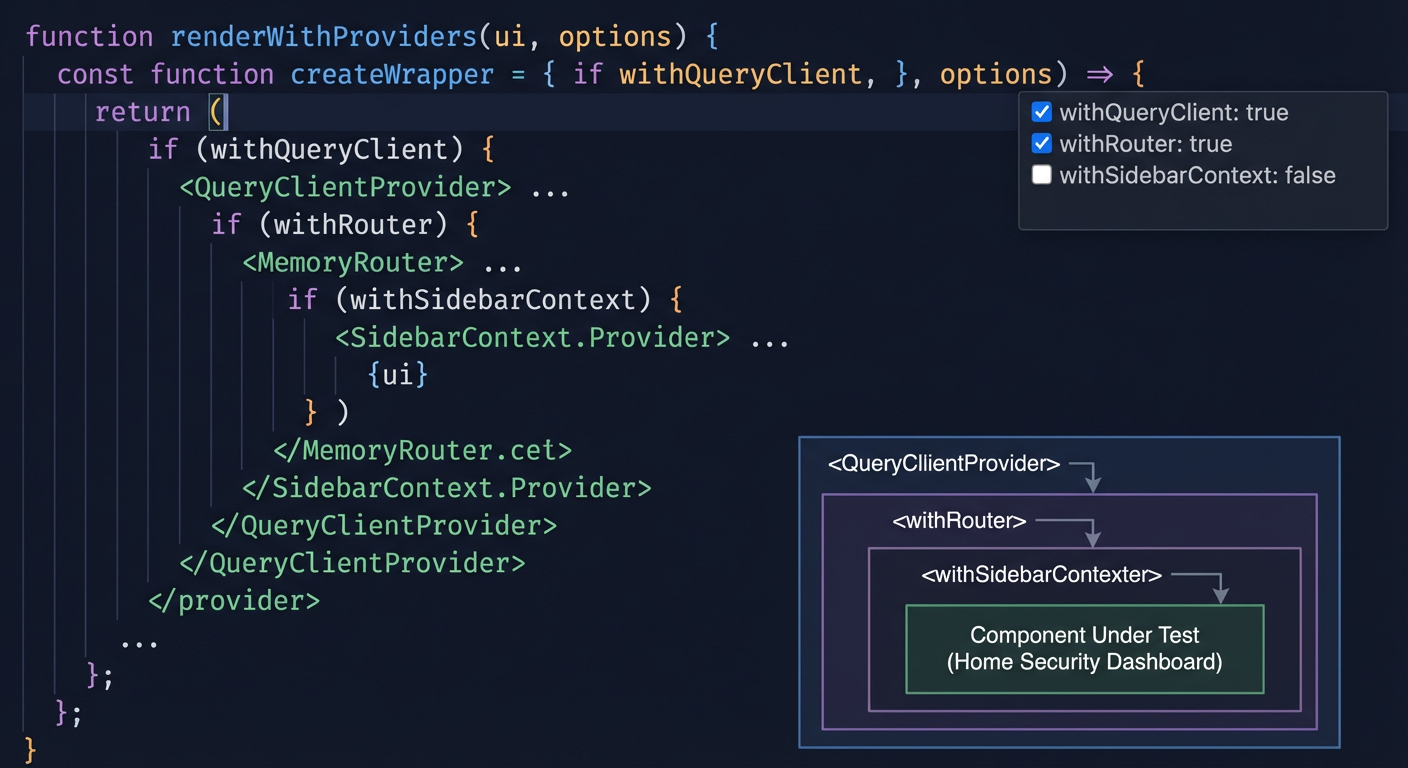
Frontend test provider tree showing the testing wrapper hierarchy for React Testing Library.
flowchart TB
    subgraph Pyramid["Test Pyramid"]
        direction TB
        E2E["E2E Tests<br/>1616 tests / 43 spec files"]
        INT["Integration Tests<br/>4174 tests"]
        UNIT["Unit Tests<br/>27726 tests"]
    end

    subgraph Coverage["Coverage Targets"]
        direction TB
        UNIT_COV["Unit: 85% diff baseline"]
        INT_COV["Integration: N/A"]
        TOTAL_COV["Combined: 80% floor"]
    end

    UNIT --> UNIT_COV
    INT --> INT_COV
    E2E --> TOTAL_COV

    style UNIT fill:#2d4a3e,stroke:#4a7c59,color:#fff
    style INT fill:#1e3a5f,stroke:#3a6a9f,color:#fff
    style E2E fill:#4a3a2d,stroke:#7a5a3d,color:#fff
    style UNIT_COV fill:#2d4a3e,stroke:#4a7c59,color:#fff
    style INT_COV fill:#1e3a5f,stroke:#3a6a9f,color:#fff
    style TOTAL_COV fill:#4a3a2d,stroke:#7a5a3d,color:#fff
Test Categories
| Category | Location | Count | Timeout | Coverage Target |
|---|---|---|---|---|
| Backend Unit Tests | backend/tests/unit/ | 27,726 tests | 1s | see below¹ |
| Backend Integration | backend/tests/integration/ | 4,174 tests | 5s | N/A (combined) |
| Backend E2E Tests | backend/tests/e2e/ | 2 files | 30s | - |
| GPU Tests | backend/tests/gpu/ | 1 file | - | - |
| Benchmarks | backend/tests/benchmarks/ | 6 files | - | - |
| Chaos Tests | backend/tests/chaos/ | - | - | - |
| Contract Tests | backend/tests/contracts/ | - | - | - |
| Security Tests | backend/tests/security/ | - | - | - |
| Test Utilities | backend/tests/utils/ | - | - | - |
| Frontend Unit | frontend/src/**/*.test.ts | - | - | floors 80/74.6/78.4/80.9 |
| Frontend E2E (Playwright) | frontend/tests/e2e/ | 1616 tests | 15s | - |
Note: The executed backend floor is 80% on combined unit+integration (scripts/validate.sh --fail-under=80, mirrored in nightly-full-gate.yml). pyproject.toml fail_under = 85 is the PR diff gate's RELATIVE baseline, not an absolute floor (owner ruling A7.1, 2026-09-19).
¹ The retired cell said "85%+"; no measurement ever produced that as a current unit-tier value (R-6: docs follow measurements). The measured numbers — with their denominators — are below.
The backend coverage numbers (WP2.1, measured 2026-09-20)
One denominator, stated: every figure below is --cov=backend over the pyproject [tool.coverage.run] tree — source=["backend"], the configured omit list, and the exclude_lines regexes — which resolves to 527 files / 78,916 statements. Both measurement paths below share that denominator exactly (verified: identical file and statement counts), so comparing them is comparing executions, not yardsticks. branch = true makes every percentage here the coverage-7.16.1 blended figure (statements+branches together, format=total); the line/branch split is given with each number.
| Path | Blended | Line | Branch | What it counts |
|---|---|---|---|---|
| Local (fallback path) | 84.12% | 86.02% | 76.27% | the PR diff gate's inline collection: pytest backend/tests/unit/ --cov=backend in ONE process — the 84.39 lineage |
| CI merged (4 shards) | 70.32% | 73.14% | 58.71% | coverage-baseline.json from run 2ab66ff1 — a known undercount, see below |
Why the CI number is an undercount (mechanism, measured same day): the repo's pytest addopts carry -p randomly (pytest-randomly), which draws a fresh shuffle seed per process. Each of the four shard jobs shuffled the suite differently BEFORE pytest-split --splits 4 sliced it, so the four --group slices overlapped and the run executed only part of the tier: run 35475023071's junit carries 27,647 case rows but only 18,520 unique tests (67%) — collect-only reproduces the arithmetic exactly (random seeds: union 18,256/27,555, pairwise overlap 1,449; fixed seed: union 27,555/27,555, overlap 0). The fix shipped in the same package: the sharded legs pin --randomly-seed=${{ github.run_id }} (identical across one run's shard jobs = disjoint + complete groups; different across runs = order randomization keeps its value). Expect the CI figure to jump ~14pp to meet the local number on the first main run with the fix; until then the CI figure understates the tier and any floor wired to it inherits the drift.
What every main run publishes (WP2.2): coverage report --format=total — the blended figure alone — used to be all coverage-baseline.json carried, so the published number was neither line nor branch coverage and neither of those existed anywhere. unit-tests-coverage-merge now also emits coverage json (the only report that exposes the split) and writes all three into the baseline: percent_covered (blended — the flat key check-test-coverage-gate.py parses; siblings added, never moved), percent_line, and percent_branch. The integration merge reports line / branch / blended to its step summary.
The wired floors (WP2.3, R-1: floors at MEASURED values):
| Floor | Value | Where enforced |
|---|---|---|
| Backend unit, absolute | 84 (WP2.5 re-measure) | unit-tests-coverage-merge, only when all unit shards passed |
| Backend integration, absolute | 37 | integration-coverage-merge, only when every integration shard passed |
| Frontend statements/branches/funcs/lines | 80 / 74.6 / 78.4 / 80.9 | merge-shard-coverage.mjs --enforce, only when all Vitest shards passed |
| Combined (unit+integration) | 80 (unchanged) | nightly-full-gate + validate.sh — now only runs when BOTH tiers passed |
| PR diff vs main's baseline | no drop past 0.5pp (epsilon) | check-test-coverage-gate.py — band = post-seed-pin noise (0.03pp ×10) |
Every completeness guard is the same rule: a floor verdict needs a full-execution measurement, so enforcement is skipped (with a warning naming the non-success tier) when a tier is red — a test failure must never arrive labeled as a coverage failure. P measured exactly that misattribution 3 of the last 4 nightly runs; scripts/test_coverage_floors.py executes the committed nightly step body against missing and complete data to pin both directions. The frontend floors replace declared 83/77/81/84, which sat above every observed run (merged 80.0/74.6/78.4/80.9, run 35486259345). The backend unit floor was 70 (the pre-WP2.1 published lineage 70.32 — an overlap UNDERCOUNT) until WP2.5 re-measured five seed-pinned runs (84.09–84.12) and raised it to 84 = observed minimum rounded down; the diff-gate epsilon likewise dropped 2.0pp → 0.5pp because its band was calibrated on the ~1.6pp overlap drift WP2.1 deleted (WP2.3's own text expected both rises "once WP2.1's seed fix reaches measurement").
Until the first fixed-seed run lands, the CI figure must not be used as the tier's strength and the local figure must not be called "the CI coverage". scripts/test_coverage_denominator.py pins this section's claims. Frontend thresholds (R-1, measured): 80% statements, 74.6% branches, 78.4% functions, 80.9% lines (see vite.config.ts coverage.thresholds).
Quick Reference
# Fast feedback (TDD cycle)
pytest --testmon                              # Only affected tests (fastest)
pytest backend/tests/unit/ -m "not slow"      # Fast unit tests only

# Full validation
./scripts/validate.sh                         # Pre-PR validation
pytest backend/tests/ --cov=backend           # All tests with coverage

# Coverage report
pytest backend/tests/ --cov=backend --cov-report=html
open coverage/backend/index.html
Running Tests
Backend Tests
# Activate virtual environment first
source .venv/bin/activate

# All backend tests
pytest backend/tests/ -v

# Unit tests only
pytest backend/tests/unit/ -v

# Integration tests only
pytest backend/tests/integration/ -v

# E2E tests
pytest backend/tests/e2e/ -v

# With coverage report
pytest backend/tests/ -v --cov=backend --cov-report=html

# Disable timeouts for debugging
pytest backend/tests/ -v --timeout=0

# Parallel execution (4 workers)
pytest backend/tests/ -v -n 4

# Affected-only tests (TDD fast feedback)
pytest --testmon
Frontend Tests
cd frontend

# Run all tests
npm test

# Run with coverage
npm run test:coverage

# Watch mode for development
npm run test -- --watch

# E2E tests (Playwright)
npm run test:e2e
Multi-Browser E2E Tests (Playwright)
The frontend E2E suite runs 1,616 tests across 43 top-level spec files (53 including user-journeys/, plus a separate visual/ suite) using Playwright. Tests execute across multiple browsers and viewport configurations for comprehensive cross-platform coverage.
Browser and Viewport Matrix
| Project | Device/Browser | Viewport | Action Timeout |
|---|---|---|---|
chromium | Desktop Chrome | 1280x720 | 5s |
firefox | Desktop Firefox | 1280x720 | 8s |
webkit | Desktop Safari | 1280x720 | 8s |
mobile-chrome | Pixel 5 | 393x851 | 5s |
mobile-safari | iPhone 12 | 390x844 | 5s |
tablet | iPad (gen 7) | 810x1080 | 5s |
Running E2E Tests
cd frontend

# Run all browsers (local development)
npm run test:e2e

# Run specific browser
npm run test:e2e -- --project=chromium
npm run test:e2e -- --project=firefox
npm run test:e2e -- --project=webkit

# Run mobile viewport tests
npm run test:e2e -- --project=mobile-chrome
npm run test:e2e -- --project=mobile-safari

# Run tablet viewport tests
npm run test:e2e -- --project=tablet

# Run with visible browser (headed mode)
npm run test:e2e -- --headed

# Run single test file
npm run test:e2e -- tests/e2e/specs/dashboard.spec.ts

# Debug mode with Playwright Inspector
npm run test:e2e -- --debug
CI Configuration
In CI, browsers run in parallel containers via the --project flag:
- Chromium job:
npx playwright test --project=chromium - Firefox job:
npx playwright test --project=firefox - WebKit job:
npx playwright test --project=webkit
Configuration details:
- Retries: 2 retries in CI to handle flaky tests
- Workers: 4 parallel workers in CI
- Artifacts: Screenshots, videos, and traces on failure
- Reports: GitHub annotations, HTML report, JUnit XML
Playwright Configuration
See /frontend/playwright.config.ts for full configuration:
- Global test timeout: 15 seconds
- Expect timeout: 3 seconds
- Navigation timeout: 10 seconds
- WebKit tests have extended 30s timeout for complex workflows
Build Validation Tests
Purpose: Detect circular dependency issues in Vite builds that can cause TDZ (Temporal Dead Zone) errors at runtime (NEM-3494).
Location: frontend/tests/e2e/specs/build-validation.spec.ts
Config: frontend/playwright.config.build-validation.ts
Background: Vite's manual chunk splitting was disabled (vite.config.ts:278-283) after circular import deadlocks between vendor chunks caused production errors. These tests ensure the build remains safe.
What the Tests Check
-
Static Analysis (File System):
-
Analyzes built JavaScript chunks for circular import patterns
- Detects self-referencing variable initializations
- Identifies excessive imports from same module
- Tracks Rollup interop helper usage
-
Monitors chunk sizes for code splitting issues
-
Runtime Validation (Browser):
- Verifies React renders without TDZ errors
- Detects reference errors during initial page load
- Validates all JavaScript modules load successfully
- Checks for duplicate module initialization
- Monitors script load order
Running Build Validation Tests
cd frontend

# Build the frontend first (required)
npm run build

# Run all build validation tests (static + runtime)
npx playwright test --config playwright.config.build-validation.ts

# Run only static analysis tests
npx playwright test --config playwright.config.build-validation.ts --grep "Build Validation Tests"

# Run only runtime tests
npx playwright test --config playwright.config.build-validation.ts --grep "Runtime Build Validation"

# Run with visible browser for debugging
npx playwright test --config playwright.config.build-validation.ts --headed
Note: Build validation tests use a separate Playwright config that:
- Serves the production build via
vite preview(port 4173) - Runs only on Chromium for consistent results
- Uses longer timeouts for build analysis (30s)
Integration with Validation Workflow
Build validation tests are not run automatically by scripts/validate.sh because:
- They require a production build (adds ~25s to validation time)
- They analyze static files (can run independently)
- Runtime tests are more appropriate for pre-release validation
When to run:
- Always: Before creating PRs that modify
vite.config.tsor build configuration - Recommended: After Vite upgrades or dependency updates affecting bundling
- Required: When re-enabling manual chunk splitting (vite.config.ts:278-283)
- Optional: As part of pre-release validation for production deployments
To include in automated validation, add to your pre-PR checklist:
# Full validation + build validation
./scripts/validate.sh && \
  cd frontend && \
  npm run build && \
  npx playwright test --config playwright.config.build-validation.ts
Interpreting Results
The tests output detailed analysis:
=== Chunk Analysis Summary ===
Total chunks: 97
Chunks analyzed: 97

Interop helper usage:
  (none detected - good sign)

Large chunks (>500KB):
  Tracker-M9IbjXzI.js: 829.95 KB
  index-A0-RzToH.js: 805.83 KB

=== Potential Issues Detected ===
(none detected)
What to look for:
- Red flags: Self-referencing patterns, excessive same-module imports (>5)
- Warnings: Chunks >1MB (consider code splitting)
- Info: Interop helper usage (normal for ESM/CJS interop)
Troubleshooting
Test fails with "Production build not found":
Port 4173 already in use:
# Kill existing preview server
pkill -f "vite preview"
# Or use a different port in playwright.config.build-validation.ts
Runtime tests fail with TDZ errors:
- Check the console error output in test results
- Review recent changes to
vite.config.tsrollupOptions - Consider if manual chunk splitting was re-enabled incorrectly
- Check for new dependencies with circular imports
Full Validation
# Full validation suite (recommended before PRs)
./scripts/validate.sh

# Backend only
./scripts/validate.sh --backend

# Frontend only
./scripts/validate.sh --frontend

# Test runner with coverage
./scripts/test-runner.sh
Pytest Configuration
The pytest configuration is defined in pyproject.toml:
[tool.pytest.ini_options]
testpaths = ["backend/tests"]
python_files = ["test_*.py"]
python_classes = ["Test*"]
python_functions = ["test_*"]
asyncio_mode = "auto"
asyncio_default_fixture_loop_scope = "function"
addopts = "-n auto --dist=worksteal -v --strict-markers --tb=short -p randomly"
timeout = 5
timeout_method = "thread"
Test Markers
Available markers defined in pyproject.toml:
| Marker | Purpose | Timeout |
|---|---|---|
@pytest.mark.asyncio | Mark as async test | - |
@pytest.mark.unit | Unit test marker | 1s |
@pytest.mark.integration | Integration test marker | 5s |
@pytest.mark.e2e | End-to-end test marker | 30s |
@pytest.mark.gpu | GPU-specific test | - |
@pytest.mark.slow | Legitimately slow test | 30s |
Timeout Configuration
Timeouts are automatically assigned based on test location (conftest.py):
| Test Type | Timeout | Configuration |
|---|---|---|
| Unit tests | 1s | Default from pyproject.toml |
| Integration tests | 5s | Auto-assigned in pytest_collection_modifyitems |
| Slow-marked tests | 30s | @pytest.mark.slow |
| CLI override | varies | --timeout=N (0 disables) |
Fast Feedback Loop (Excluding Slow Tests)
For rapid test-driven development, you can exclude slow tests to get faster feedback:
# Run tests excluding slow tests (fast feedback)
pytest -m "not slow"

# Run only slow tests (full validation)
pytest -m slow

# Run unit tests excluding slow tests
pytest backend/tests/unit/ -m "not slow"

# Run integration tests excluding slow tests
pytest backend/tests/integration/ -m "not slow"
Slow Test Thresholds: Tests are marked as slow when they:
- Take longer than 1 second (unit tests)
- Take longer than 5 seconds (integration tests)
- Require external resources (network, containers)
- Perform complex computations (AI inference, large datasets)
See scripts/audit-test-durations.py for test duration analysis.
Affected-Only Test Execution (pytest-testmon) — ADVISORY ONLY (WP2.1 DECIDE)
Status (2026-09-16): the 20-commit bake-off (selector evaluation) decided the gate-role contest:
scripts/fast_select.py(with its WP2.2 transitive closure) is the test selector for the fast tier — fault-arm recall 136/136 vs testmon 92/136, outcome arm 15/15 vs 14/16, and 0–2s stateless selection vs a 82–165s full parent run just to warm testmon's database. testmon is demoted to an advisory, developer-local tool: fine for personal TDD loops, never the gate's authority, and never a CI selector. Measured costs below supersede the pre-bake-off estimates that used to live here.
For even faster local feedback, pytest-testmon can run only tests affected by code changes (advisory — see status box):
# First run: runs all tests and creates .testmondata tracking database
pytest --testmon

# Subsequent runs: only runs tests affected by code changes since last run
pytest --testmon

# Force full test run (ignores testmon cache)
pytest

# Combine with other options
pytest --testmon -m "not slow"                    # Fast feedback: only affected, exclude slow
pytest --testmon backend/tests/unit/ -n auto      # Only affected unit tests, parallel

# Clear testmon cache (forces full re-run next time)
rm .testmondata*
How it works:
pytest-testmontracks which tests cover which source files- On subsequent runs with
--testmon, it only runs tests that cover files that changed - Significantly faster than running all tests during active development
- Best for TDD workflows and rapid iteration cycles
When to use:
- ✅ Local development: During active TDD cycles for instant feedback
- ✅ Feature branches: When iterating on a specific module
- ✅ Pre-commit checks: Quick validation before committing
- ❌ CI pipelines: CI should always run full test suite for validation
- ❌ Before PRs: Always run full validation (
./scripts/validate.sh)
Limitations:
- Only tracks Python source files (not config, templates, or external files)
- May miss indirect dependencies (e.g., fixtures, conftest.py changes)
- Cache can become stale (clear with
rm .testmondata*if unsure) - Automatically deactivated when selecting specific tests manually (e.g.,
pytest test_file.py::test_name --testmon)
Performance (bake-off measured, 2026-09-16): Warm incremental runs genuinely are cheap (selection then only the affected tests). The honest cost is everything BEFORE that: a populated .testmondata requires a FULL run of the parent commit — measured 82–165s across the sample, every single push — plus 6–17s for the selection pass itself, and stale-db runs silently fall back to large selection sets. The static selector answers the same question in 0–2s with no database to warm, share, or invalidate.
CI Integration Note: This implementation keeps testmon opt-in via --testmon flag only. CI workflows continue running full test suites by default (without --testmon). This ensures:
- ✅ CI always validates the complete test suite for reliability
- ✅ No risk of missing test failures due to stale testmon cache
- ✅ Local developers opt-in when they want fast feedback
- ✅ No CI workflow changes required
Fixtures
Shared Fixtures
Core fixtures are defined in backend/tests/conftest.py. Integration-specific fixtures are in backend/tests/integration/conftest.py. DO NOT duplicate these in subdirectory conftest files.
Synthetic Test Fixtures
Synthetic scenarios generated by NeMo Data Designer provide ground-truth validated test data for Nemotron prompt evaluation.
Location: backend/tests/fixtures/synthetic/
| File | Format | Contents |
|---|---|---|
scenarios.parquet | Parquet | 24-column scenario dataset |
ground_truth.json | JSON | Risk ranges and expected key points |
embeddings.npy | NumPy | Pre-computed semantic vectors |
images/ | PNG | Multimodal test images by scenario type |
Using the synthetic_scenarios Fixture
import pytest

@pytest.mark.asyncio
async def test_risk_score_within_range(synthetic_scenarios):
    """Test that risk scores fall within ground truth ranges."""
    for scenario in synthetic_scenarios.itertuples():
        result = await evaluate_prompt(scenario.formatted_prompt_input)
        min_score, max_score = scenario.ground_truth_risk_range
        assert min_score <= result.risk_score <= max_score

@pytest.mark.asyncio
async def test_context_usage_for_full_enrichment(scenario_by_type):
    """Test that full enrichment context appears in reasoning."""
    # scenario_by_type groups scenarios by type for targeted testing
    full_enrichment = scenario_by_type["threat"]
    for scenario in full_enrichment[full_enrichment.enrichment_level == "full"].itertuples():
        result = await evaluate_prompt(scenario.formatted_prompt_input)
        for key_point in scenario.reasoning_key_points:
            assert key_point.lower() in result.reasoning.lower()
Fixture Definitions
These fixtures are defined in backend/tests/conftest.py:
import pandas as pd
import pytest
from pathlib import Path

SYNTHETIC_FIXTURES_DIR = Path(__file__).parent / "fixtures" / "synthetic"

@pytest.fixture(scope="session")
def synthetic_scenarios() -> pd.DataFrame:
    """Load pre-generated NeMo Data Designer scenarios."""
    return pd.read_parquet(SYNTHETIC_FIXTURES_DIR / "scenarios.parquet")

@pytest.fixture(scope="session")
def scenario_by_type(synthetic_scenarios):
    """Group scenarios for targeted testing."""
    return {
        "normal": synthetic_scenarios[synthetic_scenarios.scenario_type == "normal"],
        "suspicious": synthetic_scenarios[synthetic_scenarios.scenario_type == "suspicious"],
        "threat": synthetic_scenarios[synthetic_scenarios.scenario_type == "threat"],
        "edge_case": synthetic_scenarios[synthetic_scenarios.scenario_type == "edge_case"],
    }
For more details on scenario columns and generation, see NeMo Data Designer Integration.
Database Fixtures
| Fixture | Scope | Location | Description |
|---|---|---|---|
isolated_db | function | Main conftest.py | Function-scoped isolated PostgreSQL database |
test_db | function | Main conftest.py | Callable session factory for unit tests |
session | function | Main conftest.py | Savepoint-based transaction isolation |
integration_env | function | Integration conftest | Sets DATABASE_URL, REDIS_URL, HSI_RUNTIME_ENV_PATH |
integration_db | function | Integration conftest | Initializes PostgreSQL via testcontainers or local |
db_session | function | Integration conftest | Direct AsyncSession access for integration tests |
Redis Fixtures
| Fixture | Scope | Description |
|---|---|---|
mock_redis | function | AsyncMock Redis client with pre-configured health_check |
real_redis | function | Real Redis client via testcontainers (flushes DB 15) |
HTTP Fixtures
| Fixture | Scope | Description |
|---|---|---|
client | function | httpx AsyncClient with ASGITransport (no server needed) |
Utility Fixtures
| Fixture | Scope | Description |
|---|---|---|
reset_settings_cache | autouse | Clears settings cache before/after each test |
unique_id(prefix) | function | Generates unique IDs for parallel test isolation |
Example Fixture Usage
import pytest
from backend.models import Camera

@pytest.mark.asyncio
async def test_camera_creation(isolated_db):
    """Test creating a camera with isolated database."""
    from backend.core.database import get_session

    async with get_session() as session:
        camera = Camera(id="test_cam", name="Test Camera")
        session.add(camera)
        await session.commit()

        assert camera.id == "test_cam"
Writing Tests
Unit Test Patterns
Unit tests verify individual components in isolation. All external dependencies (Redis, HTTP, file system) must be mocked.
See backend/tests/unit/AGENTS.md for complete patterns.
# Example: Mocking Redis
@pytest.fixture
def mock_redis_client():
    mock_client = AsyncMock(spec=RedisClient)
    mock_client.get = AsyncMock(return_value=None)
    mock_client.set = AsyncMock(return_value=True)
    return mock_client

# Example: Mocking HTTP clients
with patch("httpx.AsyncClient") as mock_http:
    mock_response = MagicMock()
    mock_response.status_code = 200
    mock_response.json.return_value = {"result": "success"}
    mock_client = AsyncMock()
    mock_client.post = AsyncMock(return_value=mock_response)
    mock_http.return_value.__aenter__.return_value = mock_client
Mock specs are mandatory where the role is known (M3 T9)
A bare MagicMock()/AsyncMock() accepts ANY attribute — when production later reads a renamed or removed one, the mock silently invents it and the test stays green on a lie. The rules the six M3 hot-file sweeps established:
- Mock stands in for a shipped object →
spec=that class. Sessionsspec=AsyncSession, enginesspec=AsyncEngine, ORM resultsspec=Result, settings doublescreate_autospec(Settings, instance=True), HTTP repliesspec=httpx.Response(status_code=200)(instance-spec —status_codeis not on the class dir). Child stubs on a spec'd parent (mock_session.commit = AsyncMock()) are fine; a whole invented object shape is not. - Patching a shipped function →
patch("backend.…", autospec=True). Signature drift then raises at call time. Two exceptions:autospec+new=is a TypeError (useas m; m.return_value = …instead), and a target already patched by a generator fixture's live patch cannot be re-patched withautospecinside the test (mock introspects the outer mock — InvalidSpecError; keep the outer one and skip the inner). - Pydantic v2 trap:
MagicMock(spec=Settings)does NOT enforce model-field names (fields aren't on the class dir) — it silently permits typos. Usecreate_autospec(Settings, instance=True)for real enforcement. - Spec failures are findings, not obstacles. When a spec surfaces an AttributeError, fix the stub to carry the fields production actually reads (see the init_db
use_pgbouncerfix in commit66bc45af), or document the mock as a deliberate pre-existing lie to fix forward — never over-spec-and- delete orspec_set=Noneit away.
Integration Test Patterns
Integration tests verify that multiple components work together correctly.
See backend/tests/integration/AGENTS.md for complete patterns.
@pytest.mark.asyncio
async def test_api_endpoint(client):
    """Test API endpoint with real database."""
    response = await client.get("/api/cameras")
    assert response.status_code == 200
    data = response.json()
    assert "cameras" in data
Test Organization
Group related tests in classes:
class TestCameraModel:
    """Tests for Camera model operations."""

    def test_create_camera_with_defaults(self, session):
        camera = Camera(id="test", name="Test Camera")
        session.add(camera)
        session.commit()
        assert camera.status == "online"

    def test_camera_validation_fails_empty_name(self, session):
        with pytest.raises(ValueError):
            Camera(id="test", name="")
Async Testing
All async tests must use the @pytest.mark.asyncio decorator:
@pytest.mark.asyncio
async def test_async_operation(isolated_db):
    async with get_session() as session:
        result = await some_async_function(session)
        assert result is not None
Error Testing
Always test both success and failure paths:
@pytest.mark.asyncio
async def test_handles_connection_error():
    """Test graceful handling of connection failures."""
    with patch("httpx.AsyncClient.post", side_effect=ConnectionError):
        result = await detector.detect_objects("test.jpg", "cam1", session)
        assert result == []  # Graceful failure
Coverage Requirements
Backend Coverage
Configured in pyproject.toml:
[tool.coverage.run]
source = ["backend"]
omit = [
    "backend/tests/*",
    "backend/examples/*",
    "backend/main.py",
    "*/__pycache__/*",
]

[tool.coverage.report]
fail_under = 85
show_missing = true
CI Coverage Thresholds
From .github/workflows/ci.yml and pyproject.toml:
| Test Type | Number | What it actually is (A7.1, 2026-09-19) |
|---|---|---|
| Unit | 85% | pyproject.toml fail_under = the PR diff gate's RELATIVE baseline (ci.yml publishes merged data and diffs; not an absolute floor) |
| Combined | 80% | THE executed absolute floor: validate.sh --fail-under=80 + nightly-full-gate.yml |
Note: Integration tests run in parallel shards without per-shard coverage thresholds. The only absolute backend coverage gate that executes is the 80% combined floor; it is green.
Generating Coverage Reports
# HTML report
pytest backend/tests/ --cov=backend --cov-report=html
open coverage/backend/index.html

# Terminal report with missing lines
pytest backend/tests/ --cov=backend --cov-report=term-missing
Pre-commit and CI Integration
Pre-push Hook
The parallel-tests hook runs the WP2.4 fast tier before every push (.pre-commit-config.yaml): 3 jobs selected for the pushed diff — API types contract check, backend unit+contracts selection (scripts/fast_select.py), and frontend vitest --related — under a FAST_PREPUSH_BUDGET (default 900s). See Hooks Guide.
CI Pipeline
The CI workflow (.github/workflows/ci.yml) runs:
- Backend Lint - Ruff check and format
- Backend Type Check - MyPy
- Backend Unit Tests - coverage collected; 85% is the PR diff baseline, not a run-time floor
- Backend Integration Tests - combined unit+integration checked at the 80% floor in validate.sh / nightly
- Frontend Lint - ESLint
- Frontend Type Check - TypeScript
- Frontend Tests - Vitest
- Frontend E2E - Playwright
All jobs must pass before a PR can be merged.
Database Testing
PostgreSQL via Testcontainers
Tests automatically start PostgreSQL via testcontainers when:
TEST_DATABASE_URLis not set- Local PostgreSQL on port 5432 is not available
Local Development
With Podman/Docker running PostgreSQL:
Default URLs (set in .env or via python setup.py):
- PostgreSQL:
postgresql+asyncpg://security:<your-password>@localhost:5432/security - Redis:
redis://localhost:6379/15(DB 15 for test isolation)
Note: Tests use the password configured in your
.envfile. Runpython setup.pyto generate secure credentials.
Parallel Test Isolation
Tests use these strategies for parallel isolation:
- Savepoint rollback - Each test uses SAVEPOINT/ROLLBACK
- unique_id() - Generate unique IDs to prevent conflicts
- Advisory locks - Schema creation coordinated via
pg_advisory_lock(12345) - xdist_group markers - Tests requiring sequential execution grouped
Troubleshooting
"Database not initialized"
- Use
isolated_dborintegration_dbfixture - Ensure
get_settings.cache_clear()is called - Check
await init_db()is called after setting DATABASE_URL
Parallel test conflicts
- Use
unique_id()for test data IDs - Add
@pytest.mark.xdist_group(name="group_name")for sequential tests - Check for global state mutations
Timeout errors
- Add
@pytest.mark.slowfor tests needing > 1s - Mock external services (HTTP, Redis)
- Check for background tasks not properly mocked
Import errors
- Backend path is auto-added in conftest.py
- Check module names match file structure
- Activate virtual environment
Mutation Testing
Mutation testing verifies that your tests actually catch bugs by making small changes (mutations) to source code and checking if tests fail.
Running Mutation Tests
# Run all mutation tests (backend + frontend)
./scripts/mutation-test.sh

# Backend only (mutmut)
./scripts/mutation-test.sh --backend

# Frontend only (Stryker)
./scripts/mutation-test.sh --frontend

# Specific backend module
./scripts/mutation-test.sh --module backend/services/severity.py
Target Modules
Mutation testing starts with well-tested utility modules:
| Backend Module | Frontend Module |
|---|---|
backend/services/bbox_validation.py | src/utils/risk.ts |
backend/services/severity.py | src/utils/time.ts |
src/utils/confidence.ts |
Interpreting Results
| Mutation Score | Rating | Action Needed |
|---|---|---|
| 90-100% | Excellent | Maintain current quality |
| 80-89% | Good | Minor improvements |
| 60-79% | Fair | Add targeted tests |
| Below 60% | Poor | Significant test gaps |
For detailed guidance, see Mutation Testing Guide.
Snapshot Testing with Syrupy (NEM-5021)
Snapshot testing validates API response schemas by capturing structure-only snapshots. This detects breaking changes while ignoring dynamic data like timestamps and IDs.
When to Use Snapshot Testing
- API endpoints: Validate response structure stays consistent
- Schema validation: Detect unintended field additions/removals
- Regression prevention: Catch breaking changes in CI
Basic Usage
import pytest
from syrupy.assertion import SnapshotAssertion
from backend.tests.conftest import extract_schema

@pytest.mark.integration
@pytest.mark.asyncio
async def test_get_cameras_response_schema(
    client,
    snapshot: SnapshotAssertion,
):
    """Test GET /api/cameras response schema with snapshot."""
    response = await client.get("/api/cameras")
    assert response.status_code == 200

    # Extract structure-only schema (types instead of values)
    schema = extract_schema(response.json())
    assert schema == snapshot
Schema Extraction Utility
The extract_schema() function recursively converts response data to type names:
# Input
{
    "id": 123,
    "name": "Camera 1",
    "active": True,
    "tags": ["indoor", "front"],
    "created_at": "2024-01-01T00:00:00Z"
}

# Output (snapshot)
{
    "id": "int",
    "name": "str",
    "active": "bool",
    "tags": ["str"],
    "created_at": "str"
}
Parameters
preserve_lengths=False: Use first item as representative (default)preserve_lengths=True: Preserve list lengths for validation
# Default: [item1, item2] → [schema_of_item1]
schema = extract_schema(data)

# Preserve lengths: [item1, item2] → [schema1, schema2]
schema = extract_schema(data, preserve_lengths=True)
Updating Snapshots
When schemas change intentionally:
# Run tests and review diff
pytest backend/tests/integration/api/test_*_snapshots.py -v

# Update snapshots after review
pytest backend/tests/integration/api/test_*_snapshots.py --snapshot-update

# Commit updated snapshots
git add **/__snapshots__/
git commit -m "Update API snapshots for schema change"
Best Practices
- Test all endpoints: Create, Read, Update, Delete operations
- Test error responses: Validate error schema consistency
- Test pagination: Validate pagination metadata structure
- Test empty responses: Ensure empty lists maintain structure
- Cross-endpoint consistency: Validate same resource returns same schema
Example: Complete Endpoint Coverage
# Success responses
async def test_create_resource_schema(client, snapshot):
    response = await client.post("/api/resource", json=data)
    assert extract_schema(response.json()) == snapshot

async def test_get_resource_schema(client, snapshot):
    response = await client.get("/api/resource/1")
    assert extract_schema(response.json()) == snapshot

async def test_list_resources_schema(client, snapshot):
    response = await client.get("/api/resource")
    assert extract_schema(response.json()) == snapshot

# Error responses
async def test_not_found_error_schema(client, snapshot):
    response = await client.get("/api/resource/999999")
    assert response.status_code == 404
    assert extract_schema(response.json()) == snapshot

async def test_validation_error_schema(client, snapshot):
    response = await client.post("/api/resource", json={})
    assert response.status_code == 422
    assert extract_schema(response.json()) == snapshot
Snapshot Files Location
Snapshots are stored in __snapshots__/ directories:
backend/tests/integration/api/
├── test_calibration_routes_snapshots.py
├── test_feedback_routes_snapshots.py
└── __snapshots__/
    ├── test_calibration_routes_snapshots.ambr
    └── test_feedback_routes_snapshots.ambr
CI Integration
Snapshots are automatically validated in CI:
- Test failures: Indicate schema changes that need review
- Snapshot updates: Must be committed with code changes
- Diff review: Required for all snapshot updates in PRs
Related Documentation
- Setup Guide - Development environment setup
- Contributing Guide - PR process and code standards
- Code Patterns - Testing patterns in detail
- backend/tests/AGENTS.md - Test infrastructure overview
- Mutation Testing Guide - Mutation testing with mutmut and Stryker