SSTorytime
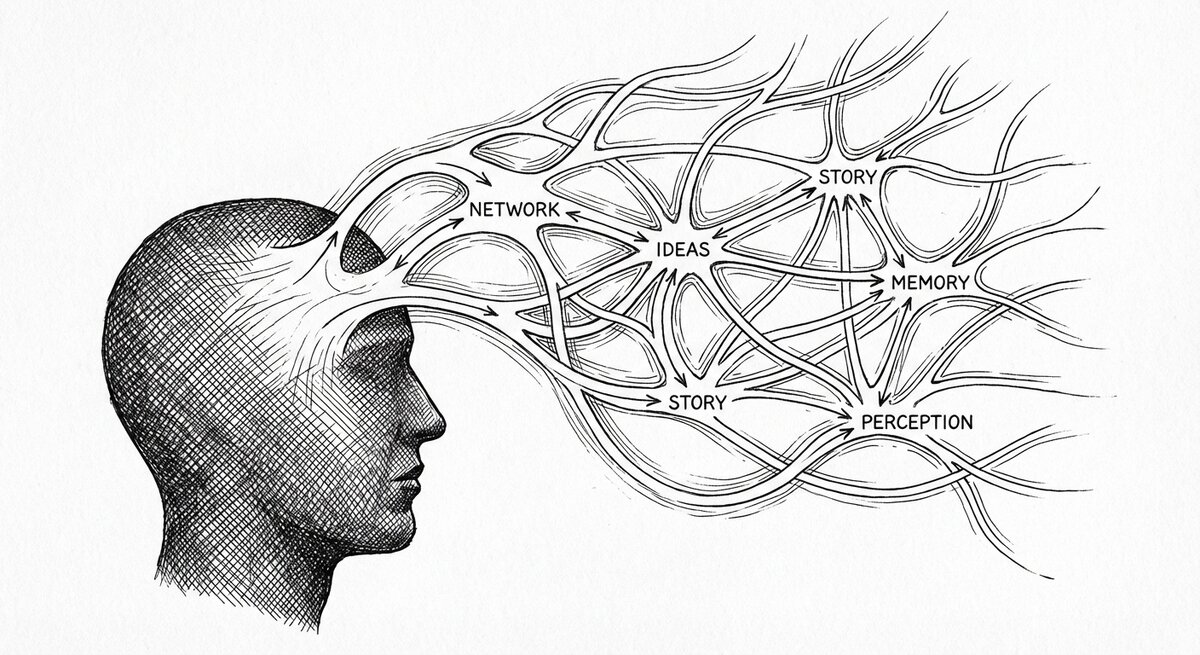
Keep notes that remember how they are connected — and ask them questions later. An NLnet-sponsored project by Mark Burgess / ChiTek-i.
Most notes go flat. You jot something down, and a week later you can't find it because the thing you typed then is not the thing you are searching for now. SSTorytime lets you write the connections alongside the content — what a book is about, what it cites, what came before, who said what — and then asks the graph, not a search box, when you want an answer.
What you can do with it
- Capture what you know, with the connections. Write notes in N4L, a plain text notation for statements like "this book is about that topic", "this decision came before that one", "this person said this". The graph comes out of the text you wrote — no schema to design up front.
- Ask questions that follow the connections. What connects these two papers? What have I read that is about decision-making? What did this meeting lead to? Questions that would be painful in SQL or a note-taking app are one line here.
- Keep the shape of your thinking. Your N4L files in version control are the source of truth; the database is a cache that makes queries fast. Your graph is yours, local, and visible.
Is this for you?
-
You want to capture something
A research trail, a decision log, a reading list, a family tree, a set of meeting notes. You have the material in your head; you want it in a shape you can ask questions of.
-
You have a corpus already
Notes, papers, transcripts. You want to explore the relationships, find paths between things, pull out what is near a given idea.
-
You want the "why" first
Semantic spacetime, context as a first-class citizen, and what this approach buys you over the alternatives.
One concrete example
Here is a small reading list written in N4L:
- reading list

 :: books, topics, authors ::

 Thinking Fast and Slow   (about)    decision making
        "                 (by)       Daniel Kahneman
        "                 (bib-cite) Judgment under Uncertainty

 Superforecasting         (about)    decision making
        "                 (by)       Philip Tetlock
        "                 (bib-cite) Thinking Fast and Slow

 Thinking in Systems      (about)    decision making
        "                 (by)       Donella Meadows
Load it, then ask: what have I read about decision making?
0: "decision making"    in chapter: reading list

      -    (is the topic/theme of) - Thinking Fast and Slow
           -    (is a bibtex citation label for) - Superforecasting
      -    (is the topic/theme of) - Superforecasting
      -    (is the topic/theme of) - Thinking in Systems
Three books. You asked about a topic; the graph also noted that Superforecasting cites Thinking Fast and Slow — surfaced by the same query, indented under the book it connects. You did not ask for the citation. It came along because it sits one hop away from something you did ask about.
The full version of this reading list is at
examples/reading-list.n4l
and is the running example in Your first story.
Install
About five minutes from a fresh checkout: Install in 5 minutes.
Background reading
A book on the conceptual background (Smart Spacetime, Mark Burgess) is available. It is conceptual background, not a tutorial.
Medium essays for deeper context:
- Getting To Know Knowledge — How Can Semantic Graphs Actually Help Us?
- What is semantic search?
- Why Semantic Spacetime (SST) is the answer to rescue property graphs
- From cognition to understanding
- Searching in Graphs, Artificial Reasoning, and Quantum Loop Corrections with Semantic Spacetime
- The Shape of Knowledge — part 1 · part 2
- Why are we so bad at knowledge graphs?
- Designing Nodes and Arrows in Knowledge Graphs with Semantic Spacetime
- Avoiding the Ontology Trap
- Using Knowledge Maps for Learning Comprehension
- Unifying Data Structures and Knowledge Graphs
- Using Knowledge Graphs For Inferential Reasoning
Discussion: SSTorytime LinkedIn Group.