Thinking in arrows
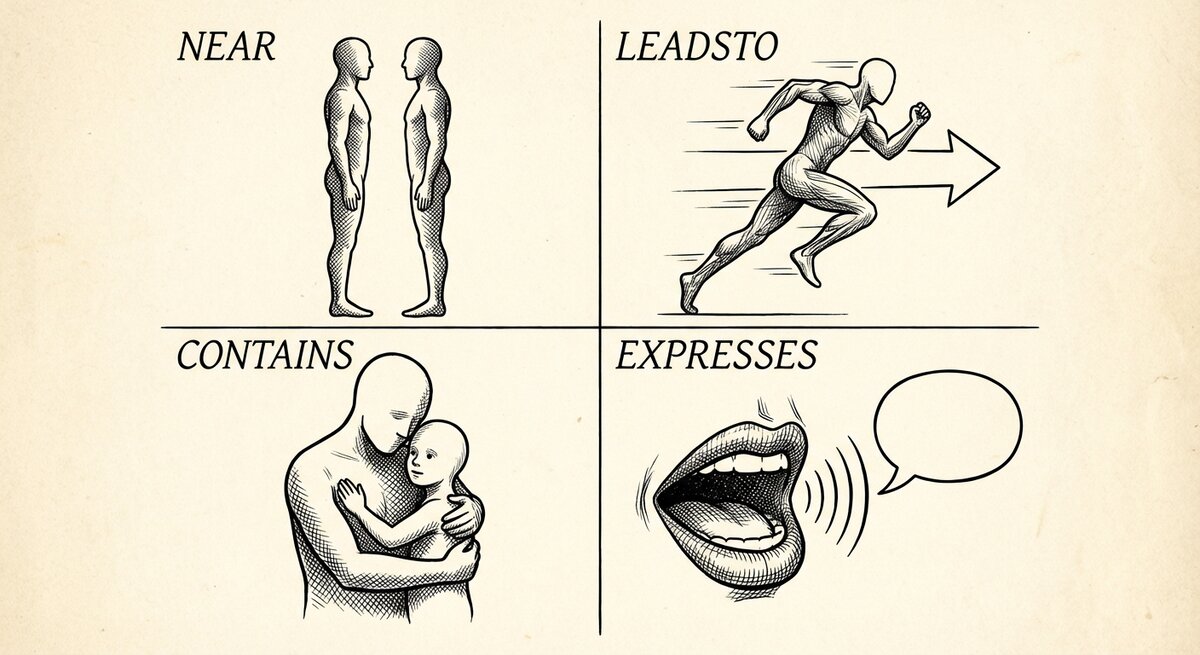
The shape of the connection is half of what you know. N4L asks you to pick the shape — from a small catalogue — every time you write a relationship down.
Most notes apps let you write arbitrary text between things and call that a link. SSTorytime asks for a little more: when you connect two things, say what kind of connection it is. That choice — same target, same source, four flavours — is what lets the graph walk sensibly across your notes later, instead of tripping over every string it sees.
There are only four flavours. The rest of this page is one short section on each, then a note about where they come from (you don't invent them; the project ships a catalogue and you pick).
Four kinds of arrow
Everything you write in N4L falls into one of four shapes. When you find yourself reaching for a new arrow, ask which shape it is and you will usually already know which short-name to pick.
Near — "these belong beside each other"
Two things that are alike, adjacent, or easily confused. Not one leading to the other, not one containing the other — just side by side. Aliases, synonyms, things-you-often-see-together, two names for the same thing.
 hokey cokey (see also) hokey pokey
 sense-making (same as) sense making
 Bīngxiāng   (sl)       Wéibōlú   // sounds like
Reach for near when you want to say "if you're thinking about one,
think about the other." In the reading list, two books about
decision making don't need a direct near arrow — they're already
connected through the shared topic. But if you had two slightly
different names for the same book, (=) or (also called) would be
the right arrow.
Leads to — "first this, then that"
One thing follows from another. Sequence. Cause and effect. What happened next. Who replied to whom.
leads to is how you write down stories, processes, decision trails.
If you find yourself narrating events in order — first X, then Y,
then Z — every arrow between them is a leads to arrow. N4L has a
shortcut for long chains of these: put them inside a _sequence_
context and consecutive lines auto-link with (then).
Contains — "this is part of that"
Whole-and-part. Membership. One thing sits inside another. The book contains the chapter; the chapter contains the paragraph; the paragraph contains the quote. Or: the team contains the person; the team is part of the company.
 human brain (consists of) forebrain
    "        (consists of) midbrain
    "        (consists of) hindbrain

 neocortex   (has-pt)   modular repeating columns in 6 layers
 column      (pt-of)    neocortex
Reach for contains when the question "is X inside Y?" has a
sensible answer. Chapters contain notes. Topics contain subtopics.
Courses contain lectures. Anything you'd draw as boxes-inside-boxes
is a contains arrow.
Expresses — "this has that property"
Attributes. Descriptions. What something is called, what it's about, who made it, what note you stuck on it. The most common arrow type by a wide margin, because most of what you write about things are properties of things.
 Thinking Fast and Slow   (about)    decision making
        "                 (by)       Daniel Kahneman
        "                 (bib-cite) Judgment under Uncertainty
        "                 (note)     two systems, one of them lazy, both of them you
Reach for expresses when you're describing a thing rather than
connecting it to another thing. (about), (by), (note),
(e.g.), (i.e.), (NB), (description), (has title) — all
expresses. The family is large because properties is where
notes spend most of their time.
Where arrows come from
The four shapes are fixed. The individual short-names — (about),
(by), (bib-cite), (then), (consists of) and so on — are
declared in a set of files that ships with the project. You
don't invent arrow names at write time; you pick from the
catalogue.
This matters because of what happens when you type (frobulates)
into an N4L file that doesn't know about it: the ingest refuses the
arrow, because it doesn't know which of the four shapes you meant.
Better to look at the catalogue and find one that fits — usually one
does.
The catalogue lives under SSTconfig/:
SSTconfig/arrows-NR-0.sst   # near / similarity arrows
SSTconfig/arrows-LT-1.sst   # leads to / causal arrows
SSTconfig/arrows-CN-2.sst   # contains / membership arrows
SSTconfig/arrows-EP-3.sst   # expresses / property arrows
Open any of them in a text editor. You'll find entries like:
 + has author (by) - is the author of (author-of)
 + is about topic/them (about) - is the topic/theme of (theme-of)
 + has bibtex citation (bib-cite) - is a bibtex citation label for (bibtex-for)
The short name in parentheses is what you type in N4L. The long
form on each side is how the graph reads it back to you — first
forward (what you wrote), then backward (what the other node
sees). So when you write Thinking Fast and Slow (about) decision
making, a query on decision making reports "is the topic/theme
of Thinking Fast and Slow." Same fact, other direction.
Fifty-plus arrows ship by default
You rarely need to add new ones. Skim the catalogue once and
you'll recognise the right arrow for almost anything you want to
say. The reading list in the tutorial uses four — (about),
(by), (bib-cite), (note) — and those four carry most of
what you'd want to note about a book.
Adding a new arrow
If the catalogue really is missing a concept you need, add it. Pick the file for the shape your new arrow belongs to, add one line, and it becomes available to every N4L file.
For example, to add has ISBN as an expresses arrow, open
SSTconfig/arrows-EP-3.sst and add a line in the right section:
Now book (isbn) "978-0-374-27563-1" parses without complaint, and
a query on the ISBN string reports "is the ISBN of book."
Two small habits that pay off later:
- Keep tense consistent. Use present tense on both sides. "has author" / "is the author of", not "had an author" / "is the author of".
- Pick short names you'll remember.
(by)reads well;(ap5)doesn't. The short name is what you'll type a hundred times.
A few habits worth picking up
Start rough. When you don't know the right arrow, write (tbd)
or (note) and come back later. Getting the note down matters more
than finding the perfect label.
Pick the shape, then pick the name. If you can answer "is this a near / leads to / contains / expresses kind of thing?" the catalogue's four files narrow themselves down immediately.
Re-use arrows across files. If you already write (about) for
topics of books, use the same arrow for topics of papers, topics of
meetings, topics of anything. A query on the topic then pulls all
of them together.
Where to go next
-
Write more
Chapters, contexts, sequences, ditto marks — the rest of what N4L gives you for shaping notes.
-
Ask questions
Now that you've got arrows, how do you query across them?
-
Understand why
Why four, why these four, and what they buy you over a free-form graph.