Your first story

In fifteen minutes you will have a queryable graph of your own reading list — and a feel for how N4L thinks.
You will write a small reading list by hand, load it, and ask it three questions. The last question's answer is the point of the whole page: connections you never explicitly asked for surface on their own.
This page assumes you have built the binaries and loaded the database per
Install in 5 minutes. If ./src/bin/N4L exists and
./src/bin/searchN4L runs without a connection error, you are ready.
What we're going to build
A short file in N4L — roughly seven books, a handful of topics they are about, who wrote them, which ones cite each other, and a one-line takeaway for each. Small enough to keep in your head, rich enough to ask real questions of:
- What have I read about decision making?
- What are my notes on Thinking Fast and Slow?
- What else does Daniel Kahneman connect to in my reading?
You will type ~20 lines, run one ingest command, and run three queries. Total time: fifteen minutes, give or take however long you spend squinting at your first query result.
Writing it down
We are going to build the file up in pieces, not dump it all at once.
Each piece adds one more thing the graph can answer. Open an empty file
called my-reading.n4l in your editor.
Your first book
Start with a title line and one book:
- my reading list

 :: books, topics, authors ::

 Thinking Fast and Slow   (about)    decision making
        "                 (by)       Daniel Kahneman
Three things to notice.
The line starting with - names the chapter. Everything else is inside it.
The line starting with :: is a context — a set of tags that frame the
section. You can ignore both of these for now; they matter when your graph
gets big enough that you want to scope searches.
Bare phrases like Thinking Fast and Slow and Daniel Kahneman are
nodes. The things in parentheses — (about), (by) — are arrows. An
arrow goes from the thing on its left to the thing on its right. So the
first line says: this book is about decision making. The second line
says: the book is by Daniel Kahneman.
The big quote on the second line (") is a ditto mark. It means "the
node from the line above." You do not have to retype the book's title.
Your graph now contains one book, one topic, one author, and two arrows connecting them.
A second book, and a shared topic
Add a second book that happens to be about the same thing:
You did not tell the graph that Thinking Fast and Slow and
Superforecasting have anything to do with each other. You just said each
of them points at decision making. But they do now: two arrows,
same target. Ask about the topic and both books come back.
This is the core of it. You do not model relationships directly. You write down what each thing points at, and the relationships fall out.
A citation
Add one more arrow:
(bib-cite) is the has bibtex citation arrow — N4L's shorthand for
"one work cites another." Your graph now has two paths from one book
to the other: the shared-topic path we already had, and the direct
citation you just added. Both surface in the query outputs below.
A few more books
Add three more so we have something to query:
 Thinking Fast and Slow     (bib-cite) Judgment under Uncertainty
        "                   (note)     two systems, one of them lazy, both of them you

 Judgment under Uncertainty (about)    heuristics
        "                   (by)       Daniel Kahneman
        "                   (by)       Amos Tversky

 Thinking in Systems        (about)    decision making
        "                   (by)       Donella Meadows
(note) attaches a short remark to a node; you can hang as many notes
off a book as you like. (by) on Judgment under Uncertainty appears
twice — a book with two authors is just a node with two (by) arrows.
Arrow types in N4L are pre-declared: about, by, bib-cite, note,
and dozens more ship in the project's config. Thinking in arrows
has the full list; for this page the ones above are all you need.
The full corpus
What you have is a decent start. The complete version of this reading list
is already in the repo at examples/reading-list.n4l — seven books, more
topics, more citations, one-line takeaways. Same shape as what you just
wrote; more of it.
For the rest of this page we will use the full file. Either keep editing your own, or switch to the canonical one.
Loading it
One command from the repo root:
-u means upload to the database. You will see a short progress block:
Uploading nodes..

Storing primary nodes ...

.

(0.0%) uploading . . .

 1 )   J O T   I T   D O W N
Storing Arrows...
Storing inverse Arrows...
Storing contexts...
Storing page map...
 W H E N   Y O U   T H I N K   O F Indexing ....
Finally done!
If you see Finally done! and no red error lines, the corpus is in. If
you see a connection error instead, your database is not running — back
to Install in 5 minutes.
Asking questions
Three queries. Each is a sentence in English, a command, and a reading of the answer.
What have I read about decision making?
You search for a string; the graph finds it as a node and shows what points at it. Something like:
0: "decision making"    in chapter: reading list

      -    (is the topic/theme of) - Thinking Fast and Slow
           -    (is a bibtex citation label for) - Superforecasting
      -    (is the topic/theme of) - Superforecasting
      -    (is the topic/theme of) - Thinking in Systems
Three books, reachable because each wrote an (about) arrow at the same
target. The arrow names render in their inverse form — you wrote
(about), the graph reads it back as (is the topic/theme of) from
the topic's side. Same fact, other direction.
Look at the indented line under Thinking Fast and Slow: the graph also noticed that it is the citation target of Superforecasting, and tucked that in. You asked about a topic; you got back the books AND a citation relationship between two of them, for free.
What are my notes on Thinking Fast and Slow?
This pulls the full orbit of one book:
0: "Thinking Fast and Slow" in chapter: reading list

      -    (is about topic/them) - dual-process cognition
      -    (note/remark) - two systems, one of them lazy, both of them you
      -    (is about topic/them) - decision making
      -    (is about topic/them) - heuristics
      -    (has author) - Daniel Kahneman
      -    (has bibtex citation) - Judgment under Uncertainty
           -    (is about topic/them) - cognitive bias
           -    (has author) - Amos Tversky
           -    (note/remark) - the anchor is almost always the wrong number
      -    (is a bibtex citation label for) - Superforecasting
Everything you ever said about this book, plus one step further: the book it cites, Judgment under Uncertainty, shows its own topics, author, and takeaway indented underneath. The graph walked one hop out without being asked — that is the orbit.
What does Daniel Kahneman connect to in my reading?
This is the one.
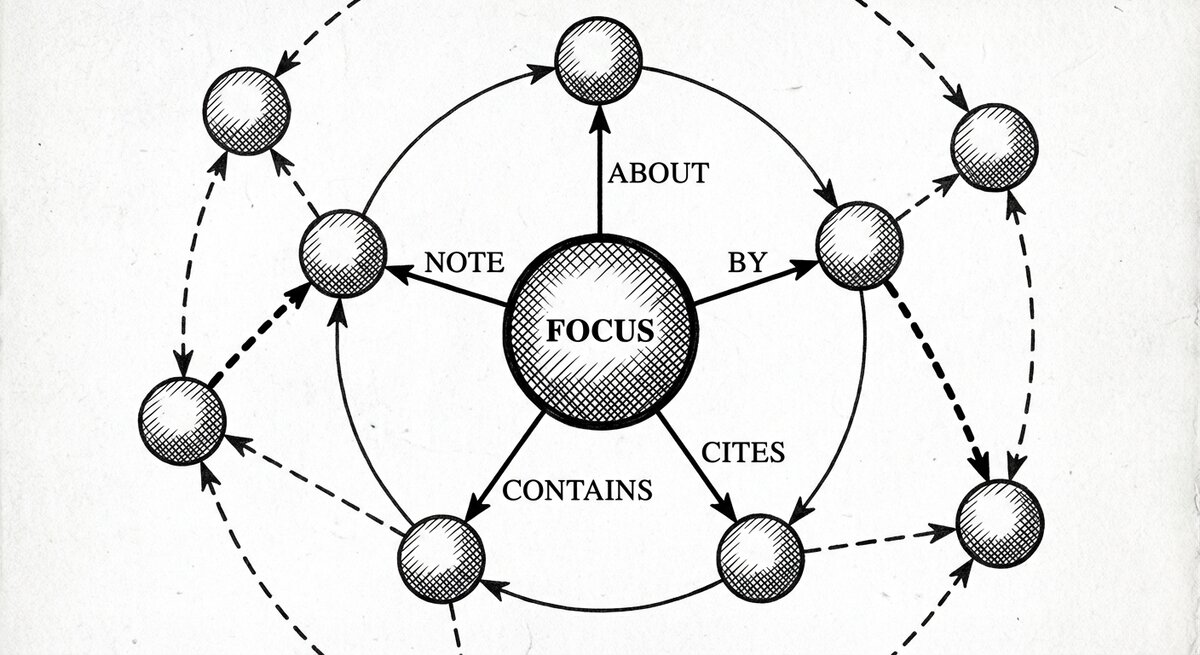
You ask about a person. You get back:
0: "Daniel Kahneman"    in chapter: reading list

      -    (is the author of) - Thinking Fast and Slow
           -    (is a bibtex citation label for) - Superforecasting
      -    (is the author of) - Judgment under Uncertainty
Kahneman wrote two books — you told the graph that directly. But the indented line says Thinking Fast and Slow is cited by Superforecasting. You did not ask about Superforecasting. You did not write anything connecting it to Kahneman. It surfaced because it is one hop away from something Kahneman authored, and the graph walks one hop out of every neighbourhood.
That is the whole idea.
What just happened
- You wrote it. Twenty lines of plain text. No schema designed in advance. No code. No SQL.
- You loaded it. One command. The database is a cache; your N4L file is still the source of truth and lives in your editor and your version control.
- You asked it. Three questions in English-shaped commands. The hard one — "what does Kahneman connect to?" — surfaced a citation relationship you never mentioned in the question, because the graph walks one hop out from whatever you ask about.
You just built a knowledge graph. If you extend the file and run the
upload again, it grows. If you throw the database away, N4L -u rebuilds
it from your file in seconds.
Where to go next
-
Keep writing
The arrow types, the chapters, the contexts — more on what they are for and when to reach for each.
-
Ask bigger questions
Orbits, paths, context-scoped searches, sequences. The shape of a question, not the flags.
-
Understand why it works
Semantic spacetime in plain English. Why connections are written the way they are, and what that buys you.