Concepts
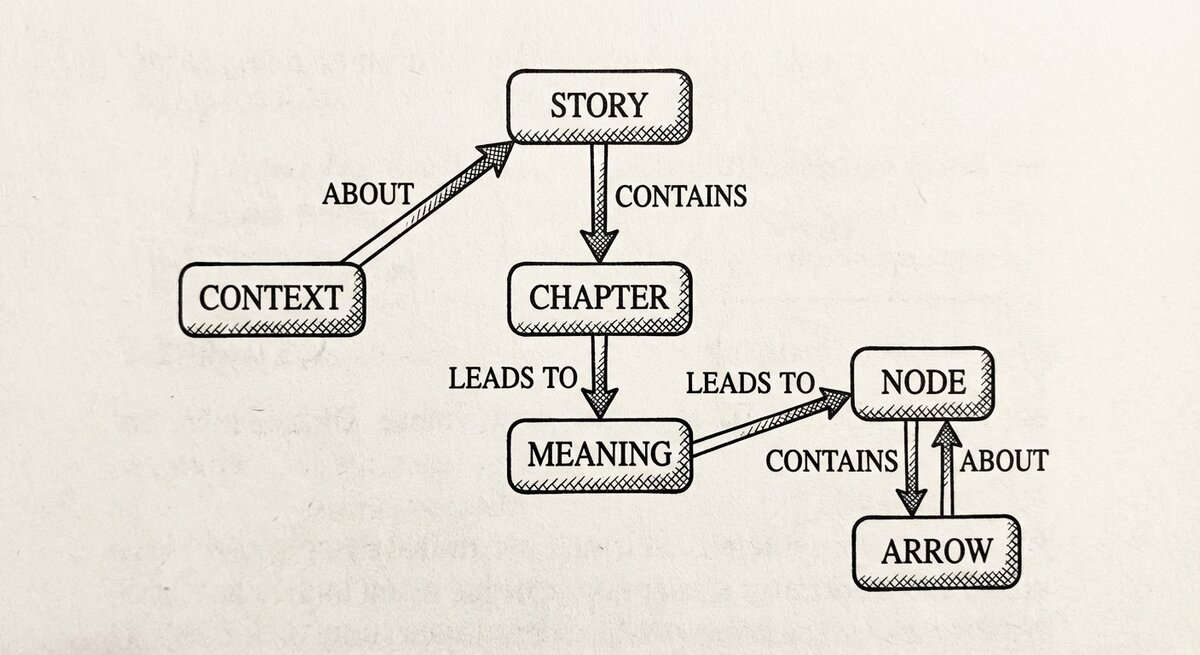
The "why" behind SSTorytime — short enough to read before you install, deep enough to come back to when a query surprises you.
Most knowledge tools ask you to decide what your data is before you can write any of it down. A schema, an ontology, a folder hierarchy — you pick the shape up front, and the material has to fit. That works when you already know the material; it fails on exactly the thing you wanted help with in the first place, which is learning the shape as you go.
SSTorytime takes the other route. You write down what you know, a line at a time, saying what points at what. The shape falls out of the writing. The only vocabulary you have to agree on is a small palette of how things relate — similarity, sequence, containment, property — and every arrow you ever draw is a flavour of one of those four. That is the semantic spacetime idea, and the pages below unpack it.
You do not have to read this tab to use the tool. The reading list tutorial teaches by doing. Come here for the picture behind it.
-
Why semantic spacetime?
The argument. What RDF and OWL got wrong, what "four arrows" buys you, and when the model is the right tool versus when it is not.
-
Glossary
Arrow, chapter, context, cone, orbit, story, wave-front — a pocket dictionary of the words this project throws at you, each entry leading with what you do with the concept.
-
Thinking in arrows
The four arrow types in detail, with examples of how the same English phrase can map to different arrows and why the choice matters when you come back to query.
-
How context works
Context is the hard problem of knowledge management. How SSTorytime splits it — what was in the scene versus what you are looking for — and why the split is load-bearing.
The longer essays — Storytelling and Knowledge and learning — are Mark's original writing on why this tool exists at all. Read them when you want the voice rather than the reference.